Civic Engagement: The Actionability/Generativity Matrix
Oct 21, 2026 · Jon Garfunkel
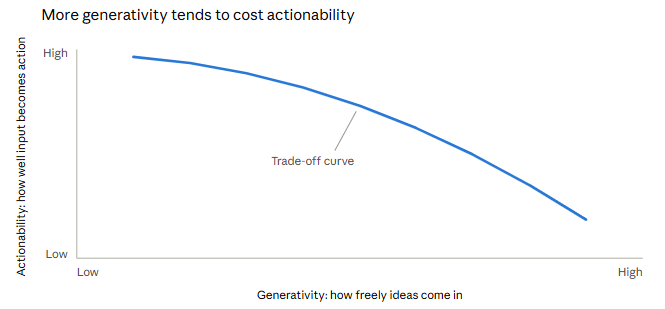
Civic engagement tools can be compared on two scales: generativity, how freely ideas come in, and actionability, how well a group turns them into things its leaders can do. Most tools sit along a trade-off curve, where gaining one costs some of the other. This essay places forums, petition sites, and engaged consultations on that curve and looks at where each falls short. It then proposes two ways past the trade-off: software built around the whole governance process, as described by the Participatory Governance Framework, and adoption through small groups that already exist, such as advisory boards and civic clubs.
Picturing government as a box
Think of a government as a black box. Residents put inputs in: comments, complaints, ideas. Outputs come out: ordinances, budgets, services. Most people want to know the inputs and the outputs without sitting through the meetings in between. The media, old and new, fills that gap by interpreting what went in and what came out.
The input/output model comes from David Easton, who in the 1950s and 1960s as a box that takes in demands and support and turns out decisions and policies, with feedback carrying the results back in. Robert Dahl, writing with Edward Tufte, between broad participation and a system’s ability to act.
In the 1990s, a few appeared, but they were short-lived and local. By the mid-2000s, more politics and policy had moved online. The end of the first decade saw the launch of Facebook, Twitter, the iPhone and App store. Around 2010, Tim O’Reilly that government should work like a platform, publishing its data and services so that others could build applications on them, much as developers build apps for a smartphone. The Internet let than existing systems can handle. Over the last 15 years, much civic tech has aimed at helping officials process what comes in: sorting it, summarizing it, and routing it to someone who can respond.
The natural next step is to apply the input/output model to the apps themselves: the forums, surveys, petition sites, and meeting tools through which people deal with their government. Martin King has started down this path. He that a platform is usually one part of a wider process and should be judged by the input, throughput, and output of that whole process, and he ends by calling for comparative work on “which elements of deliberation tend to be supported or neglected by developers of online deliberation platforms.”
This essay takes up that call in a simpler form. I fold throughput into output, since residents judge a process by whether it carries their ideas through to something leaders do. The essay also asks whether civic tech works better through one large box, at the state or metropolitan level, or through many small ones, such as the boards, clubs, and councils residents already belong to.
Measuring civic tech tools
I wanted to place these apps on a simple matrix, corresponding to inputs and outputs. The closest antecedent I found is from Fabrizio Li Vigni at the Centre for Internet and Society in France. In , he reviewed four popular civic tech implementations and proposed a three-dimensional matrix comparing relationships between organizers, software architecture, and infrastructure.
The cube is a useful framework. I wanted something simpler that I could draw on a page and add to.
I also wanted to look at a broader range of apps. Facebook Groups isn’t generally thought of as a civic tech app. And yet, a large number of people worldwide use it for their local community interactions.
Here’s how I’ve named the inputs and outputs:
- is how freely ideas and feedback come in, with few gates, and whether others can see them, build on them, and find each other around them.
- Actionability is how well a group turns what comes in into things its leaders can do, such as updates to policy, law, or documentation.
Weighing the trade-off
Leaders may be stymied trying to increase both measures at once. More generativity, meaning more ideas and more participation, makes it harder for civic leaders to keep up. The less moderated and less structured a forum is, the more time it takes them to engage with it.
I see the tension in my own town. Facebook often seems to be a mess of civic angst (though the real names make it a little more polite than Reddit; the work of group moderators provides greater control than Nextdoor does). Many comments seem cynical and attacking. Facebook once made an effort to provide that show alongside a user’s name; they no longer do. Elected officials know they need Facebook to reach residents and to set the record straight, but many are wary of a platform they can’t control, where criticism comes fast. And yet, all the same, Facebook is, in many ways, a more open forum than making public comments at a town hall.
The civic tech matrix
I’ve added several civic tech platforms to the chart, along with Facebook Groups, Nextdoor, and Reddit in the bottom right. Individual groups on the same platform may score very differently, but my sense is that these rough patterns hold.
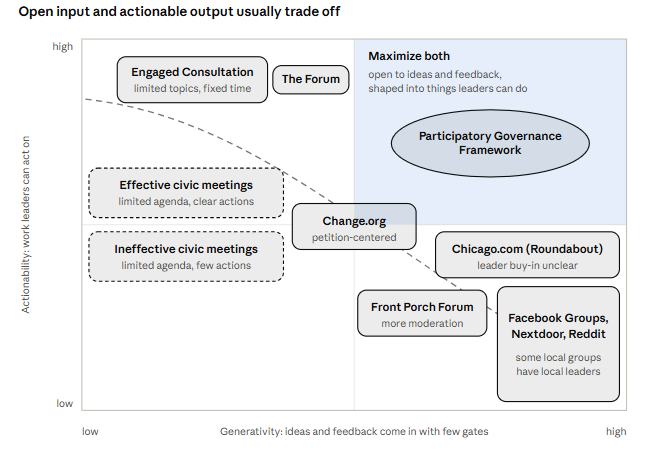
I also put civic meetings on it alongside the technology. Indeed, with Zoom for remote access and AI for transcription, meetings are more technical than ever. Still, the basic structure of an ordinary meeting has changed little.
Digital tools make data collection easier; they don’t necessarily drive generativity. A form that collects ideas privately leaves respondents unable to see or build on each other’s.
Further development of the scales and deeper research into each platform could provide detailed placement. A few heuristics give a rough reading in the meantime:
- Generativity rises with the share of the community that knows about it and uses it, the number of questions and ideas submitted, and how many of those contributions others see, reply to, or build on.
- Actionability rises with the number of leaders who take part, the share of ideas that get a response, and the share that lead to an action.
A group that logged each idea it received and what became of it could report these numbers directly. Better ways to measure both would follow from that, and would make platforms easier to compare.
Modes of civic technology
I look at three modes of civic effort commonly in use today: forums, petition sites, and engaged consultations. Most designs sit along a trade-off curve: more generativity tends to cost some actionability, and the reverse.
Online forums
A forum is an open, ongoing conversation among residents, and it is the oldest of the modes. The WELL and the put communities online in the 1980s, and today an estimated 43% of American homeowners turn first to local Facebook groups to connect with their neighbors. Anyone can write a post or question anytime. Nothing obliges a leader to read it, so actionability is low unless someone takes on that job. There have been many efforts to build new forums over the years, and a few, old and new, stand out.
Many Facebook groups are not, on the surface, about politics; they are about interests like gardening and nature. Still, they may at some point make decisions together, which is politics by another name. I return to that point below.
Front Porch Forum
Front Porch Forum was recently praised by PBS NewsHour as “a different kind of social network, one grown locally” in Vermont. It began in 2000 as a neighborhood list in Burlington, and subsequently launched as a business and website in 2006. It now has over 235,000 active members, just under half of the state’s adults. Members use real names, messages arrive in daily digests, and moderators enforce civil discussion. It is lower on generativity than Facebook because it moderates heavily, so much so that people whose participation was “moderated out” created a competing site Vermont Back Porch. How it does on actionability is a bit unclear. The system doesn’t directly support the legislative process, though it does appear to be correlated with greater political activism outside the system.
Chicago.com and Roundabout
The civic tech nonprofit New_ Public took inspiration from Front Porch Forum to create a new community forum platform called Roundabout. They have partnered with Chicago Public Media to create Chicago.com, which launched in Fall 2026. These are stewarded neighborhood communities. Each has a local steward, paid by New_ Public in the pilots, who maintains and convenes it.
My sense is that Roundabout is an improvement over Facebook Groups, but how specifically, I don’t know. I can’t find a feature comparison list. Paying stewards is admirable, but not really sustainable. Where would the money come from in each community?
Online petitions
A petition site lets anyone start a request and collect signatures. The intake is wide, but each petition is a single ask that others can sign and cannot add to, so generativity is lower than in a forum. At the same time, these often call for clear and specific actions.
Change.org
Change.org was founded in 2007 and lets anyone start a petition and collect signatures. Each day, its users create 2,000 petitions, add 500,000 signatures, and send notifications to 1,000 decision-makers. One in 80 petitions are ultimately marked close by the petition creator -- presumably because they acheive the desired action. Care2 and Avaaz are competing petition platforms.
Petitions are simple to understand, valuable for democracy, and easy to measure: each gets a response or it doesn’t. But they reflect a simplistic view of democracy, in which the petition is the primary voice citizens have.
Join (Taiwan)
Taiwan’s Join, run by the National Development Council since 2015, requires a government response within two months once a petition gathers 5,000 signatures in 60 days.
Engaged consultations
An engaged consultation is a highly structured process, which generally starts with buy-in from a sponsoring government body or agency. It has stricter controls to provide a more fixed output for the public officials. It’s a process an organizer runs, with a set of topics and a fixed window for submissions. The trade-off is that generativity is limited.
Before the web
Engaged consultations predate the Internet. James Fishkin devised deliberative polling in 1988. A deliberative poll gives a sample of residents balanced briefing materials and time to discuss in small groups, then surveys them again to see how their views changed. Fishkin ran these for Texas state energy planning in the 1990s to help build support for wind and solar power generation. New York City faced a similar need in rebuilding after the 9/11 attacks. In July 2002, AmericaSpeaks ran a similar process Listening to the City for the agencies rebuilding Lower Manhattan: about 4,300 people reacted to six preliminary plans for the World Trade Center site, and within a week officials said the plans would be redrawn.
Speak Up St. Louis
St. Louis also turned to a consultation when a large sum arrived: the city received $250M from a 2021 lawsuit settlement over the Rams football team’s move to Los Angeles. To engage citizens in the disbursement process, the city worked with the Belgian firm CitizenLab (now Go Vocal) to solicit and analyze local feedback. That effort has since become Speak Up St. Louis, which works more like a gated petition platform.
The Forum
Go Vocal also powers The Forum, run by the nonprofit OnePeople, Inc. It is working in Nevada, New Hampshire, and South Carolina through 2026, and a community has to engage its team to take part. Residents contributed ideas by text, voice, and video during the 2026 submission period, and in Nevada the goal is to find solutions that more than 70% of participants support.
Engaged California
Engaged California launched in February 2025 and is run by the state’s Office of Data and Innovation with Carnegie California. The first engagement asked Los Angeles fire survivors to weigh in on ten recovery topics. About 8,000 people signed up, and some 2,500 responded. A state-employee engagement followed. The pilot ended in a report with recommendations, and officials said they would use the results as a road map. It’s unclear what new topics are on the horizon, or whether they are extending it to the local level.
Assessing the modes
- Online forums: These are widely used, but moderation is labor: volunteers burn out without backup, and paid stewards need funding each community has to find. A common identity service for assuring residency/constituency would also go a long way. Volunteer moderators could be served by something like an “American Community Moderators Association.” Eli Pariser of New_ Public noted in 2024 that nothing like it exists. I’ve asked around, and as of 2026 there still isn’t one.
- Petition sites: While these have wide appeal, they work by public pressure, which suits a last resort and makes a poor first step with the leaders who must act.
- Engaged consultations: These are great where they are employed. They require a sponsor. A resident with an idea outside the submission window or topics has nowhere to send it.
Who gets involved?
Tools that aim for the upper right of the chart depend on steady participation, which most people don’t give. In his study of New Haven, Robert Dahl as homo civicus: people whose attention goes to family and work, with politics a distant concern. These people want to talk with their neighbors, so they go where the neighbors already are, which may be Facebook, Nextdoor, or Reddit.
Dahl also described a small subset of citizens as homo politicus, people interested in politics and policy who spend some portion of their week pursuing it. Much of civic tech rests on the hope that lower entry barriers will bring more people into politics.
Researchers have asked whether the Internet lowers those barriers. Revolutions lower them without help, since fewer people can afford to stay on the sidelines, and Granovetter’s describes how each person who joins makes it easier for the next. That makes the Internet’s contribution hard to separate. Zeynep Tufekci that online networks let movements form quickly but often leave them unable to turn size into lasting influence. Most Americans are not in a revolution, though. In a time of , more people can afford to stay on the sidelines.
Pew surveyed American Facebook users in March 2024, with the quadrennial presidential election getting underway. Just 26% saw politics as a major or minor reason to use Facebook, compared with 74% who cited connecting with others who share their interests.
The 26% may reflect how most of us use the word. We tend to picture politics as the work of professional operators and local schemers, and we could conclude that most people prefer apolitical experiences and have no need for civics. But we naturally form groups with others, and as those groups grow, they need internal governance. Sooner or later, outside events affect the group as a whole, and some members argue that the group should act. That collective decision-making is politics in the sense Aristotle meant when
So groups are, in some ways, political, and that’s a good thing. We should recognize that and make it easier for groups to make political decisions. Civic tech tools are one way to help groups make those decisions together.
Our solution
Generating more ideas is easier; turning them into something leaders can act on takes work. A group needs a way to take all the comments, ideas and rants and try to cast them into concrete proposals.
Moderation is the most familiar way to do this. It can be gentle, as when a moderator asks someone to rephrase a post or move it to another channel, or strict, as when posts are deleted. Either way it takes people. Professional moderators cost money, and volunteer moderators often struggle to show why their calls should carry weight. AI moderators could provide the necessary impartial insight, though that work is still early. Moderation, human or AI, works *inside* a conversation.
Two structural choices can fill that gap. The first is software built for the whole process, which carries a discussion through to a proposal and a decision. The second is to make the box smaller, closer to the problem. Groups already organized around solving a particular problem have a head start, because their members agree on what they are there to do.
Architecture: software for the whole process
Over the last two decades, many software tools have emerged worldwide to help with deliberation. The ones built around the whole process fold forums and petitions into a single tool and follow an issue end to end, from a resident’s first concern through the decision to the tasks that follow. They are meant to be turn-key, and could run without an outside consultant. Many are open-source and free. These tools aim for the upper right of the chart, beyond the typical trade-off: open to ideas, and able to turn them into things leaders can do. I put together the Participatory Governance Framework as a vocabulary for describing that process.
Decidim is a leading example. Barcelona’s city council launched it in 2016, and it is open-source, so other places can run their own copy. Its site lists more than 570 instances in 36 countries, about 65 percent of them run by public institutions. Residents propose projects, debate them in threads, mark arguments as favorable, unfavorable, or neutral, and follow what the city decides. Fabrizio Li Vigni, in the paper mentioned earlier, ranks it highest on his cube. He credits its stronger ambition to share decisions with residents, its richer deliberation tools, and at least a partial commitment to commons-oriented infrastructure. The CivillyEngaged PGF Scorecard also rates its features favorably.
Loomio works at a smaller scale. It is open-source software built by a worker-owned cooperative in New Zealand, and groups use it to discuss proposals and reach decisions. It charges each group a single price that covers all its members. About a decade ago, a committee of the National Assembly for Wales used Loomio to keep a reference group of service users and providers talking between its in-person meetings, and participants said the online discussion made the second meeting more focused.
A more recent case is Witchcliffe Ecovillage in Western Australia, about 100 households that govern themselves in place of a conventional strata manager. Each of its five neighborhood clusters runs its own Loomio group, which holds the minutes, agendas, and decisions. When residents first opened Loomio to everyone, they found they needed more structure, and a working group now guides proposals through a set process before a decision. Loomio also rates well on the PGF Scorecard, though like most governance tools it does less with the tasks that follow a decision.
Adoption: smaller boxes
Many of the high-profile systems, particularly engaged consultations, go big, working with states and big cities. They commonly emerged to address crises (post-9/11 rebuilding in Lower Manhattan, a sports team leaving town, the LA wildfires). At that scale more money is involved, but more importantly, there’s a wider net to catch the engaged minority.
A state or large city can bring together strangers who share an interest and would barely meet otherwise. A small town will likely draw from a smaller pool of prospects, and the active few probably know each other already, so a new town-wide platform adds little for them. , such as a municipal advisory board or nonprofit advocacy group, has members, a purpose, and a leader, so a tool can be adopted by people who already work together.
These are small boxes, with inputs and outputs that residents can work with. Most likely they use some email today, but they tend to rely on in-person meetings or synchronous Zoom calls. These function as a sort of gate: if you’re interested, show up. There are fewer gateways for people who can’t regularly attend, or who want to contribute on their own time.
What’s in the way of adopting a more hybrid approach? Many organization-minded folks who join such groups have professional jobs in workplaces with collaboration software. They just don’t have the same software in their civic lives. Why not? The question is worth some research, but my personal experience points to a few answers. First, in a workplace the software is usually chosen from above, and most people use it because their job requires it; they can supplement it by working face-to-face. In a volunteer group there is no “above” to require it, and members don’t mind simply discussing things in person at a monthly meeting. Second, these systems are still evolving, and their parallel streams of collaboration commonly overwhelm all but the most dedicated volunteers. Third, the popular workplace collaboration tools are priced for business use: $10 to $20 per user per month. This price makes sense for someone working 8 hours a day, not 8 hours a month.
Eventually, the obstacles will fade: civic software will get more robust, adoption will get easier, and prices will come down. Government would then be a collection of digitally powered civil society groups, many small boxes in place of one large one, each with its own members, its own inputs, and its own outputs. This is how we see civic tech succeeding.